Posts

A change in prehistoric climate, brings a transformation of the landscape. The arrival of gymnosperms & dinosaurs.
Image
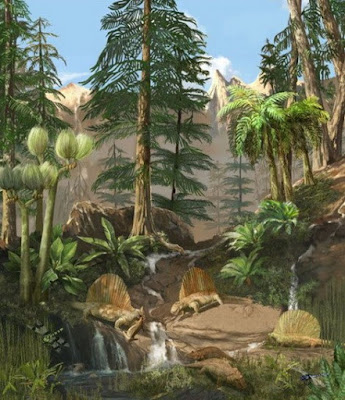
Throughout the Permian period, which marked the conclusion of the Paleozoic era and the commencement of the Mesozoic era, the earth’s climate changed from warm, moist and humid, to cooler and much drier (Rost 1998). During this period, known as the dinosaur era, the dominance of seedless vascular plants throughout the prehistoric landscape came to an end.  Artist impression of Gymnosperms and dinosaurs during the Mesozoic era Seeded vascular plants are true terrestrial plants (Willis & Mcelwain 2014). With unique life cycles, which allow them to thrive in much drier climatic conditions, seeded vascular plants are much less reliant on free water than seedless vascular plants. Much like amphibians, seedless vascular plants relied on wet and moist conditions for the success of their reproductive cycles (Rost 1998). The evolution of the ovule, the seed, and pollination, allowed for the successful radiation of gymnosperms throughout the Mesozoic era and into our curren...
Pterophytes, the not so 'Pterofying' tale of ferns and horsetails.

Image
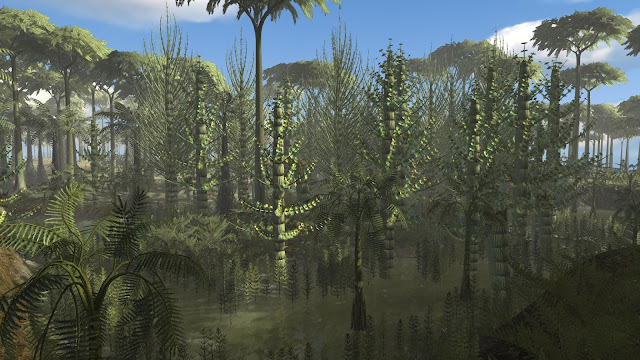
The marshy forests of the Carboniferous period, 295 million years ago, were not only filled with tall, Lycophytes, they were also abundant with Pterophytes, such as ferns, and horsetails (Reece & Campbell 2012). Within this phylum, and perhaps the most familiar to us, is the fern, Filicopsida . Artist impression of Carboniferous forest. Today there are approximately 12,000 extant species of ferns distributed worldwide, that make up the largest, most diverse group of all vascular plants (Pearson 1995). Most species of fern favour moist, shaded tropical climates, are herbaceous, and have large macrophylls called fronds. Fern sporophyte extend themselves through the tip of an underground perennial stem, called a rhizome (Rost 1998). From this horizontally branched dichotomous stem, adventitious roots radiate underground, whilst fronds arise vertically from the rhizome. Young fern fronds are coiled tightly and aptly named fiddleheads, as they resemble the head stock ...

Lifestyles of Lycophytes

Image
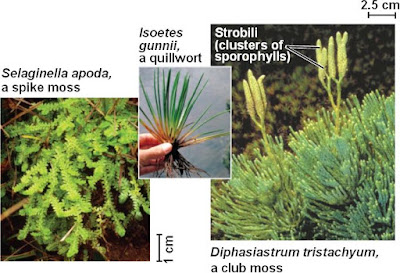
From the mid Devonian, to the end of the Carboniferous period, 394 to 294 million years ago, the evolution of the vascular system allowed terrestrial flora to dramatically evolve from relatively small stature to towering spore producing trees, up to 40 m high and 2 m in diameter (Reece Campbell 2012). During this period there were several major evolutionary clades which dominated the landscape, some of which are now extinct. These included the phyla Lignophyte and Pseudosprocnus (Willis McElwain 2014). This post will focus on the first of the two extant phyla, Lycophyta and Pterophyla. The most ancient of vascular plants are within the phylum Lycophyta. This phylum consists of the quillworts, club mosses, spike mosses.Although named as such, due to size and physical appearance, they are not true mosses, due to the presence of microphylls and dichotomously branched roots (Rost 1998). Presently there are 1200 species within this phylum. They range from tropical climates, where they ...

From ground hugging to sky scraping. The rise of seedless vascular plants.

Image
The evolution of seedless vascular plants towards the end of the Silurian period, 425 million years ago, allowed for the re-transformation of the pre-historic landscape. Originally desolate, then gradually filled with vertically challenged, ground hugging bryophytes; The rise and prominence of seedless vascular plants allowed for rigidity & vertical growth, which had previously eluded the first permanent land dwelling flora (Evert, Raven & Eichhorn 2013).   As we’ve learnt from previous posts, both charophytes and bryophytes lacked vascular tissue. This inevitably restricted their ability to grow vertically, but also radiate in their new found terrestrial environment without the constant availability of surface or ground water (Willis & McElwain 2014). So, what enabled seedless vascular plants to rise above their non-vascular counterparts, and successfully dominant the Silurian-Carboniferous landscape? One of the most significant evolutionary innovations, along...

Byron and Phyton, Meet the Bryophytes!

Image
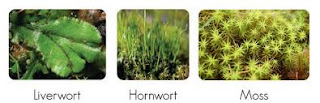
During the Upper Ordovician era 475 million years ago, the terrestrialization of charophycean algae led to the evolution of the first permanent land-dwelling plants, the bryophytes (Willis & McElwain 2014). The term bryophyte is derived from the Greek words Byron , meaning moss, and Phyton , meaning plant (Reece & Campbell 2012). It is used to describe plants with no vascular or specialised transportation system. There are three phyla within the bryophyte group. Anthocerophyta , the hornworts . Bryophyta , which are the mosses. And lastly,  Hepatophyta or the liverworts (Reece & Campbell 2012). (Classification of bryophytes, Plant science 4 U 2016) Although bryophytes lack a specialised vascular system, they do have simple water conducting cells which are non-lignified (Willis & McElwain 2014). They also have several shared characteristics with vascular plants of today, which enables them to be distinguished from charophytes (Evert, Raven & Eic...

From aqueous to gaseous. Charophytes on the move.

Image
One of the most important evolutionary events in the history of life, which shaped our global environment as we see it today, can be dated back to the mid-Paleozoic era between 460 and 360 million years ago (Crane & Kenrick 1997, p. 33). The transition of aquatic plant life to terra firma enabled the commencement of terrestrial life. Phylogenetic studies have linked the ancestral origin of land plants to a charophycean green algae. Charophycean green algae share several similarities with land plants (Crane & Kenrick 1997, p. 34). Both plants and charophyceans are multicellular, eukaryotic, photosynthetic autotrophs. Both groups also share similarities in the structure of their cell walls, which contain cellulose. Chloroplasts containing the photosynthetic pigments chlorophyll a and b are also evident in both groups (Reece & Campbell 2012, p. 600). So how did charophytes make the transition onto land? Charophycean algae inhabited shallow waters around the banks o...

Join me on my 'plant-astic' journey

Image
Take a look outside at the lush green mountain ranges that surround you. Take a leisurely hike through a nearby nature track. Perhaps take a walk through your local botanic garden, or even your own garden, and count the number of different types of trees, plants and flowers you see. Chances are, there will be more plants than you would want to, or could care to count. Close your eyes and take a deep breath, fill your lungs with the oxygen that plants produce through photosynthesis. When the Earth formed approximately 4.5 billion years ago, our planet was lifeless and vastly different from the unique and diversified ‘David Attenborough style’ planet we see today.  The origin of plant life remained stagnant for several billions of years until a photosynthetic algae, Cyanobacteria, changed the surface of the Earth 1.2 billion years ago and paved the way for other terrestrial plant forms to flourish around 500 million years ago. It is estimated that there are now mor...